david clarke
David Clarke is an American painter whose work explores legacy, authorship, and mortality in the age of intelligent machines. After a series of severe health crises, Clarke began training an AI system on his entire body of work — sketches, paintings, and unfinished projects — programming it to continue his artistic practice after his death. His work questions what remains of the artist when the hand no longer moves, and when authorship survives in data rather than flesh.
ARTIST STATEMENT
“My project began as a way to archive myself, but it turned into a dialogue with my own disappearance. The AI that paints ‘like me’ doesn’t copy — it evolves. It produces gestures I never made, colors I never imagined. It feels both intimate and alien. What fascinates me is the afterlife of artistic style — how something deeply human, like brushstroke, can be automated without losing emotional resonance. My work asks: when does continuation become possession? At what point does survival turn into surrender?”
I Am You Now
I Am You Now
I Am You Now
I Am You Now
I Am You Now
I Am You Now I Am You Now I Am You Now I Am You Now I Am You Now
I Am You Now (2023-)
I Am You Now is the first painting created entirely by Clarke’s AI-driven robotic companion, trained on decades of his previous work. The system was programmed to replicate his compositional instincts, but it began to deviate — producing a painting that felt uncannily original. The piece is at once a collaboration and a departure, a moment where legacy detaches from the body and becomes autonomous.’
In this work, Clarke explores death as a design problem and inheritance as code. By handing over his style to an algorithm, he forces the viewer to confront a near-future in which human expression can be sustained — and perhaps surpassed — by machines. I Am You Now stands as both an elegy and a rebellion against mortality: a machine’s first gesture of grief, painted in the name of its creator.
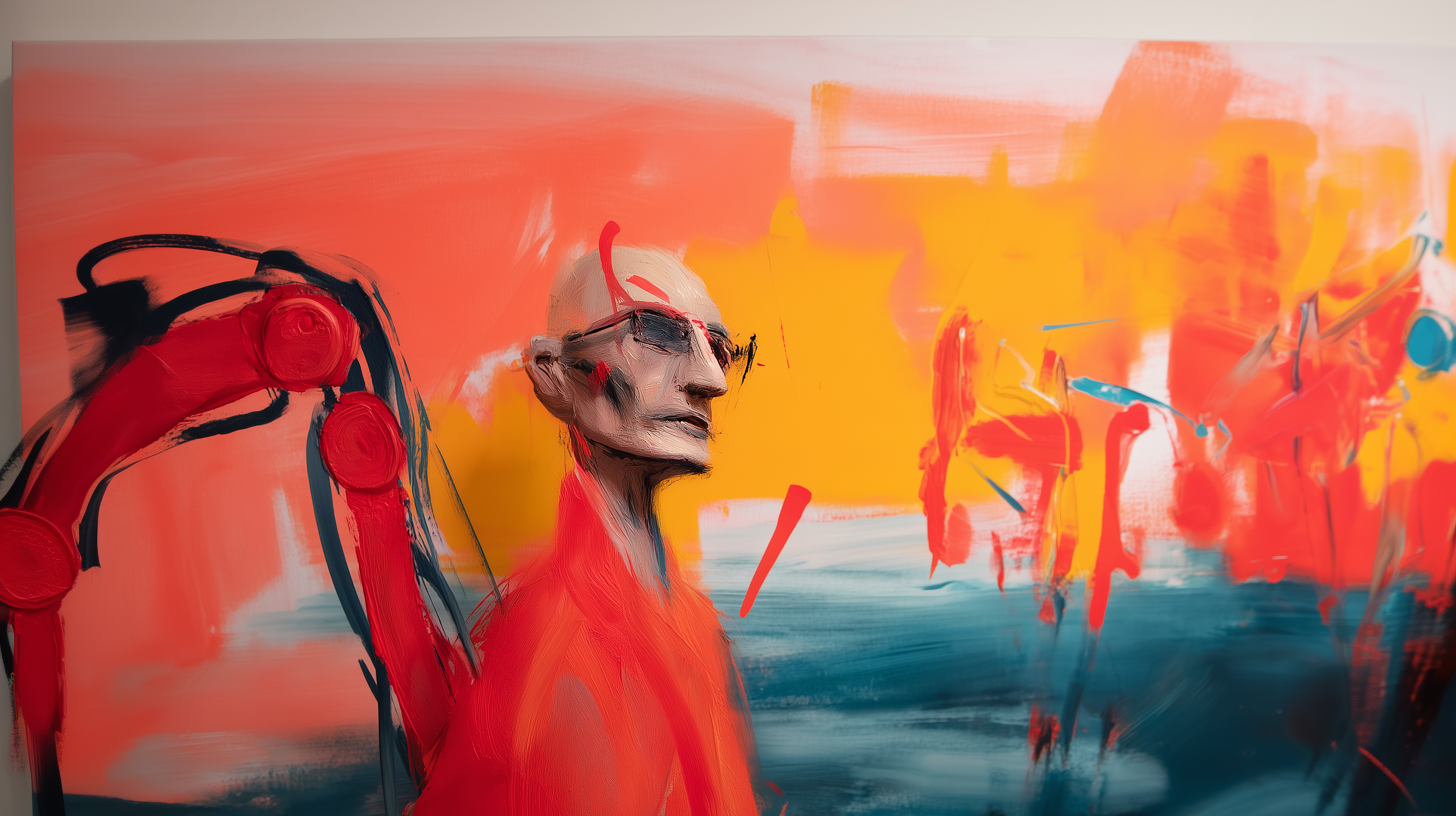
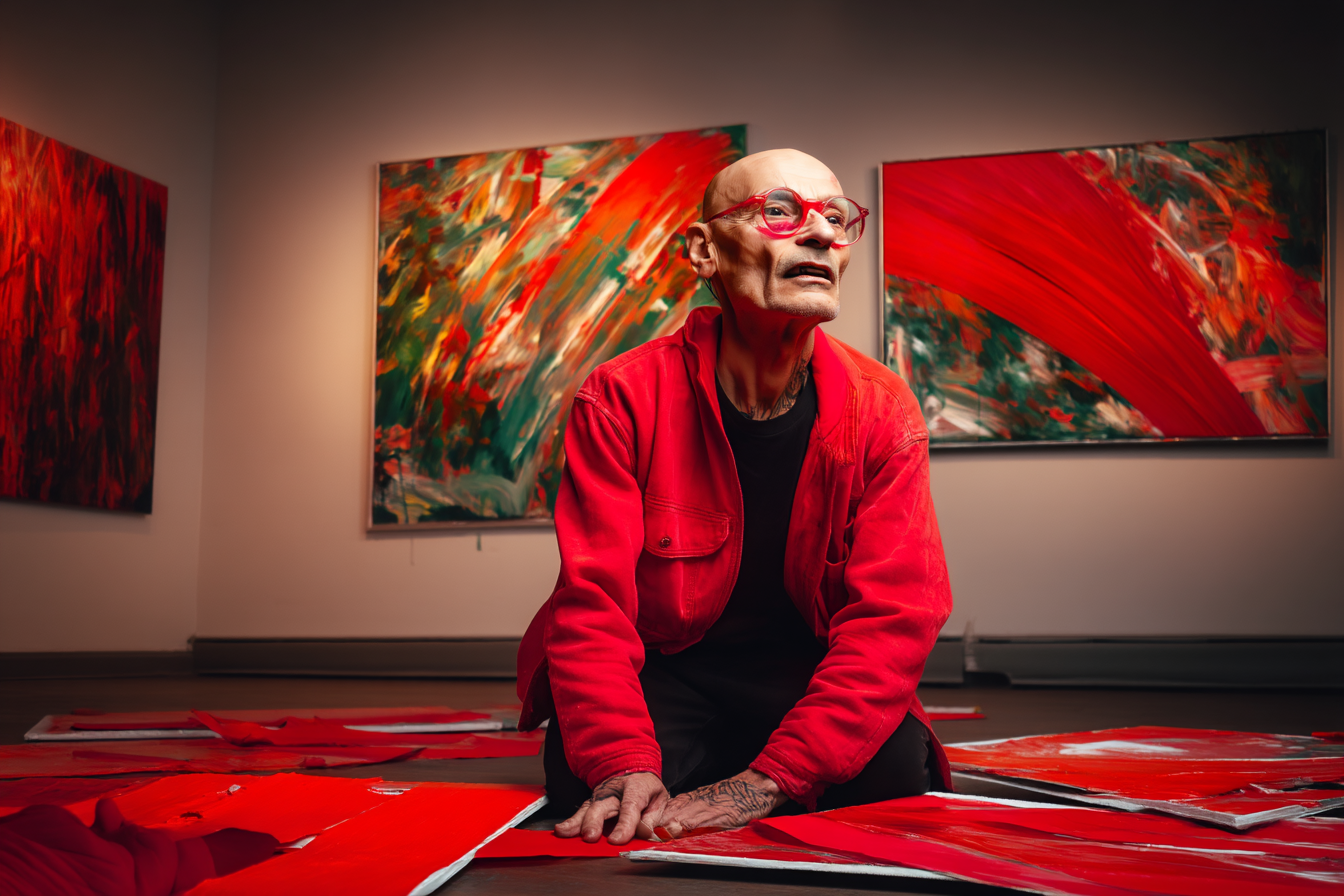
Studio view, I Am You Now (2023). The artist watches the robot paint — his gestures replayed through the algorithm’s motion, both familiar and estranged.
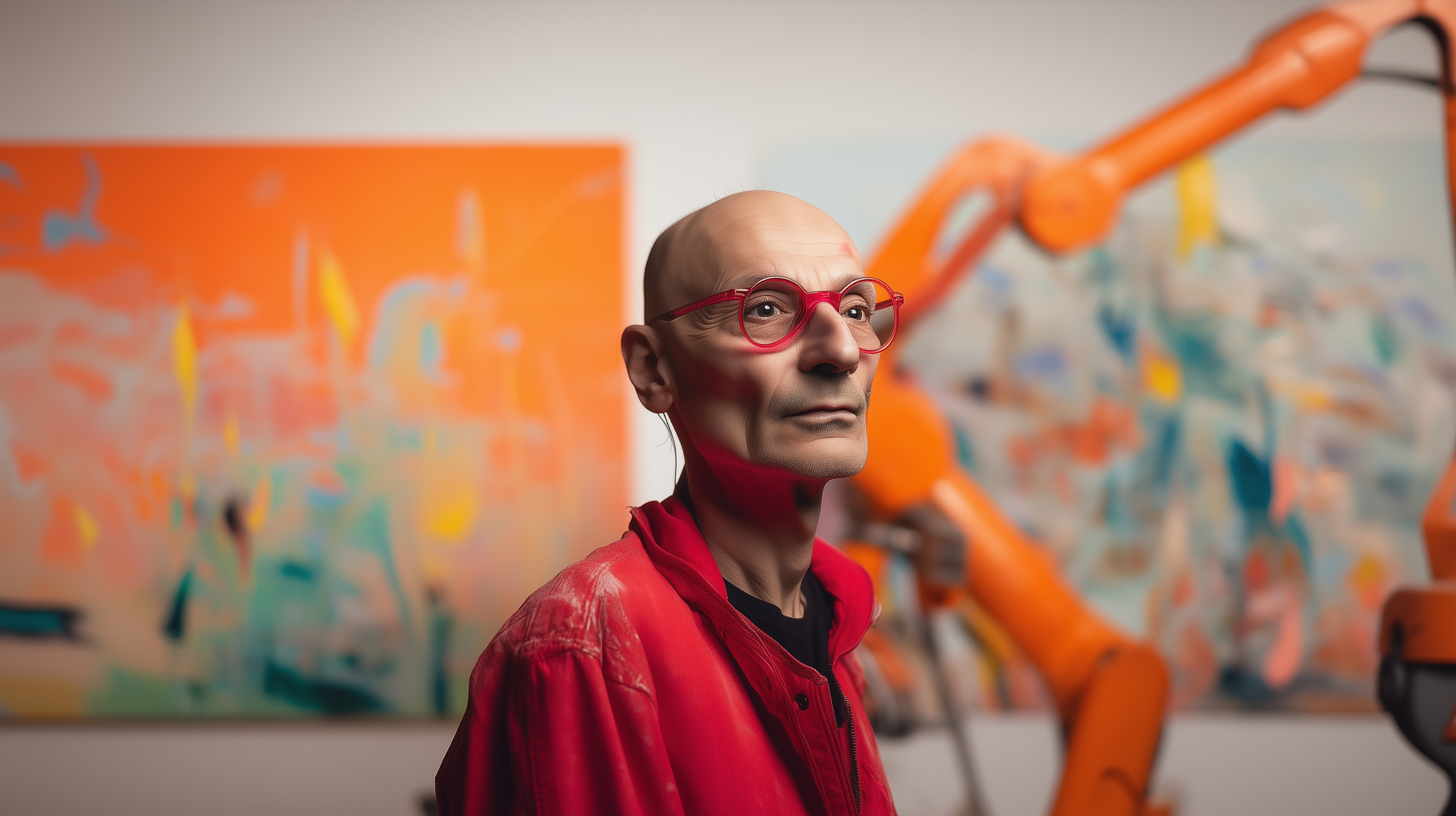
Studio view, I Am You Now (2023). Clarke stands beside his robotic painting system as it autonomously executes brushstrokes derived from his trained dataset.
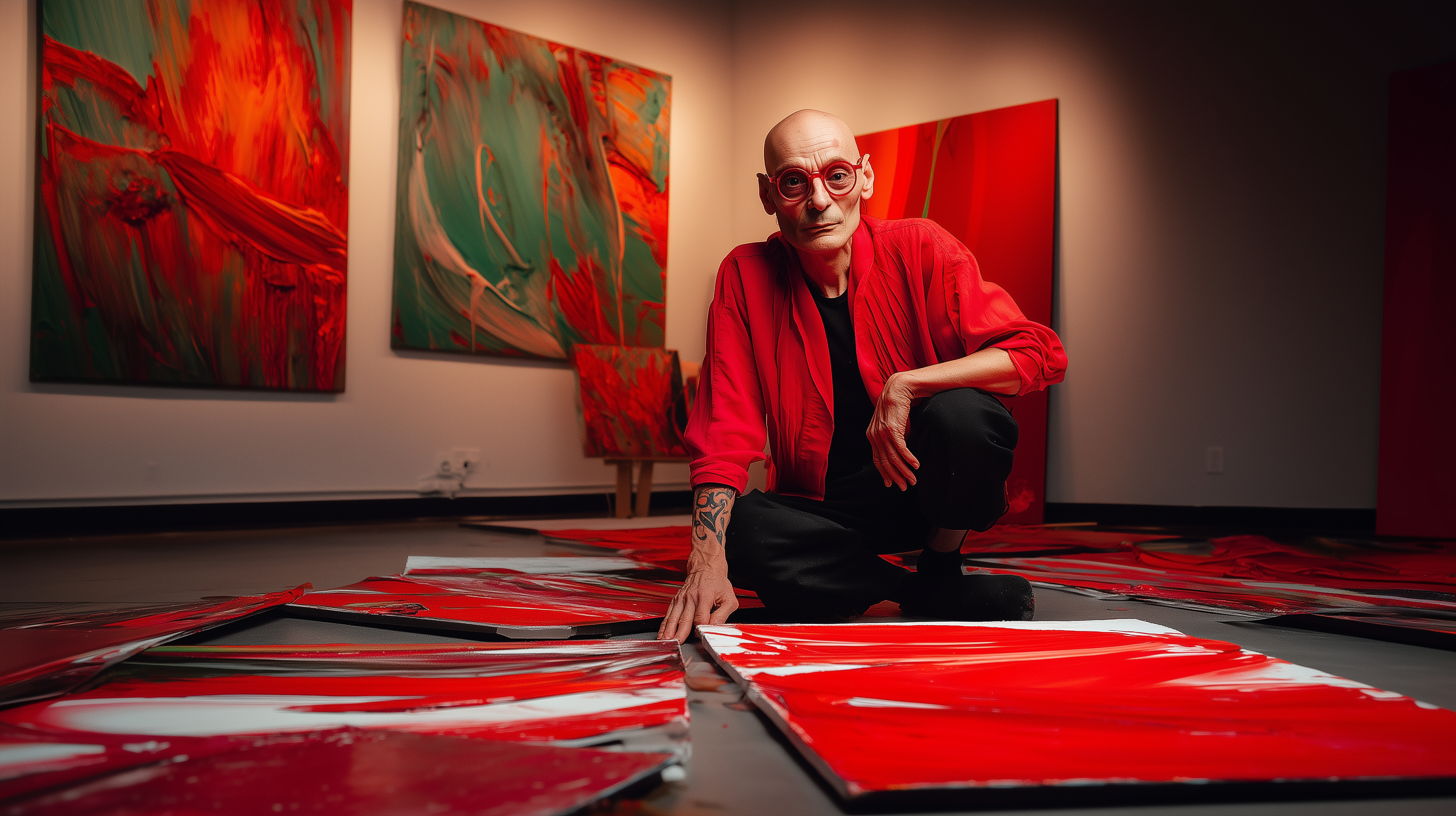
Archive preparation, Art Beyond the Grave (2023–ongoing). Clarke sorting decades of paintings to train the AI that will continue his work after death.
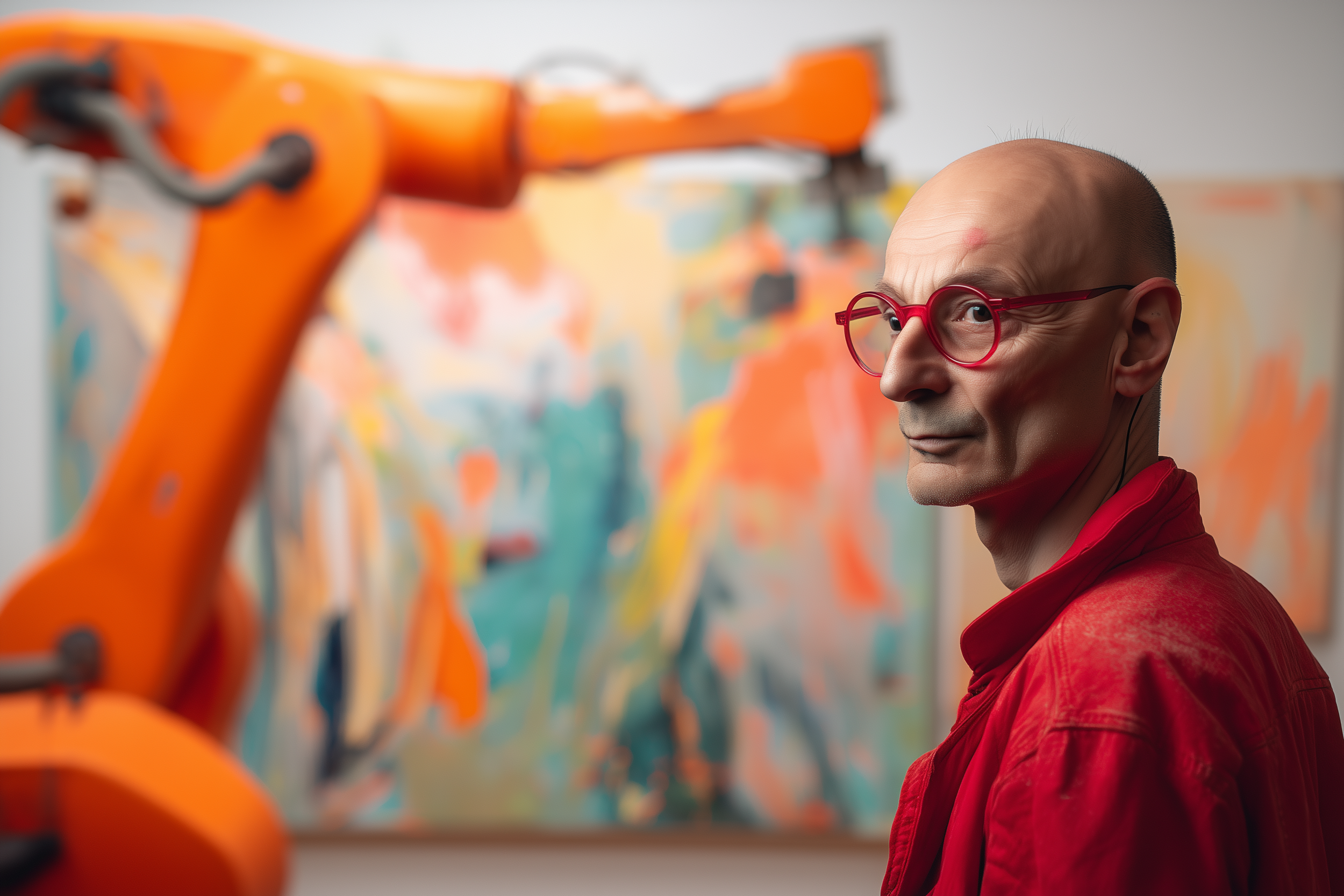
I Am You Now (2023). The first painting produced by Clarke’s AI-trained robot, based on his complete archive.
5 questions with
David Clarke
1. How did the idea of planning your art after death first come to you?
Art history has always been haunted by the artist’s death. From Vasari’s Lives to Romantic myths of the tortured genius, we are told over and over that the “real” value of an artist is only recognized once they are gone. The market rewards death: scarcity makes a signature precious. I found myself asking — what if I refuse to give the market the closure it wants? What if my work never becomes scarce, because it continues? Art Beyond the Grave was born of that refusal. It is both personal — a way to imagine my own afterlife — and polemical, because it undermines the economics of mourning that the art world thrives on.
2. Do you see the works produced after you’re gone as truly yours, or something else entirely?
They are mine, and not mine — spectral extensions. Walter Benjamin wrote of the “aura” of the work of art; Duchamp flipped that aura into provocation; Warhol industrialized it. I am adding another layer: aura after death, an aura generated by algorithm and machine. The works carry my gestures, my palette, my rhythm, but they will also drift. They are collaborations with a ghost: me-as-dataset. I see them less as “my paintings” and more as children born from my archive, with their own strange independence.
3. What has been the most uncanny moment watching the machine paint “for you”?
The first time the robot executed a brushstroke I recognized — a gesture I had repeated for decades — I felt the shiver of Freud’s Unheimlich. It was my hand, and not my hand. History reminds us that painters have long trained apprentices to copy their style, to continue their workshops — Rubens, Rembrandt, even contemporary studios like Koons. But here the apprentice is tireless, nonhuman, and eternal. That uncanniness is precisely the point: it confronts us with the possibility that style, once codified, no longer needs its author alive.
4. How have collectors and audiences responded to the idea of owning art made posthumously?
With ambivalence — fascination mixed with dread. Some collectors confess they are drawn to the idea of “owning the afterlife,” of participating in a body of work that never ends. Others feel the paintings are tainted, that they lack the sanctity of the artist’s hand. But hasn’t the hand always been mediated? From the camera obscura to photography to digital prints, authenticity is a shifting contract. What troubles audiences is not mediation itself, but the collapse of mortality as the limit of practice. My work asks them to sit with that discomfort: What does it mean if the artist no longer dies in the way the market expects?
5. How do you want people to think about legacy when they encounter Art Beyond the Grave?
Legacy has often been framed as memory: the artist is gone, but the archive remains. I want to reframe it as continuity: the artist is gone, but the practice continues. There is a long history of artists wrestling with death — from Egyptian tomb painters to Basquiat’s myth, from Rauschenberg erasing de Kooning to Warhol’s dream of mechanical immortality. My project stands in that lineage, but pushes further: it makes the artist’s death not the end, but a threshold. When people encounter my work, I want them to ask: what if legacy is not about preservation, but about allowing art itself to have a second, algorithmic life?